
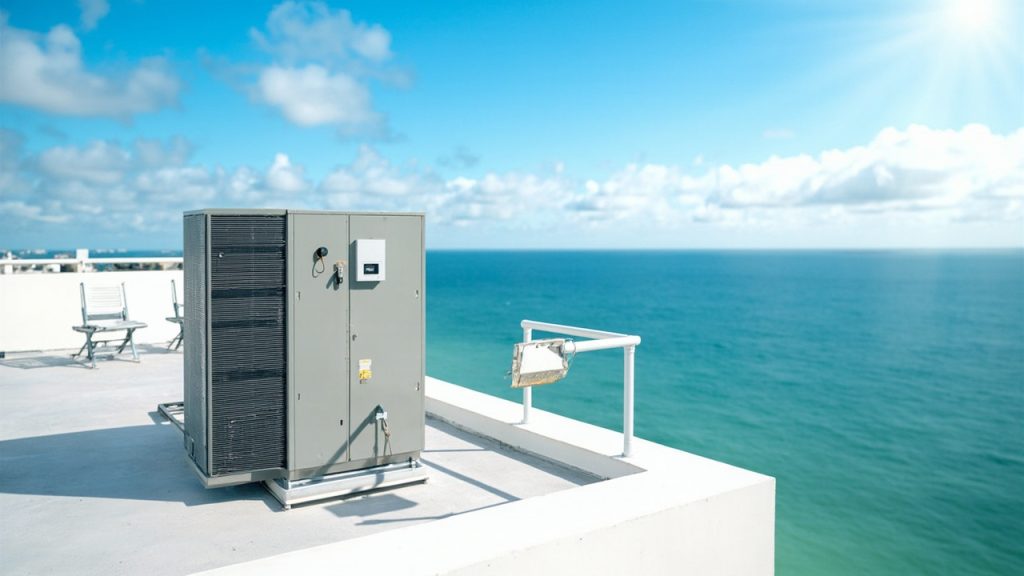
Owning a rental property in Miami Beach requires a strategic approach to mechanical maintenance. The heat stays consistent throughout the year. Your tenants likely keep the air conditioner running at low temperatures even when they leave for the day. This constant demand puts immense pressure on your HVAC system. Many landlords now ask whether investing in a high SEER2 system is a wise financial move in 2026. The answer depends on your long term goals for the property and how you manage utility costs. In our tropical environment, the difference between a standard unit and a high efficiency model involves more than just a lower power bill. It involves the survival of your investment against the relentless humidity and salt air of the Atlantic coast.
SEER2 stands for the Seasonal Energy Efficiency Ratio 2. This measurement tells you how much cooling an air conditioner provides per watt of electricity used. In our tropical climate, the numbers matter because the equipment runs for thousands of hours every year. A unit with a higher rating uses less power to move heat out of the building. For a property in South of Fifth or Mid Beach, this efficiency leads to changes in monthly operating expenses. You must weigh the higher purchase price against these long term operational savings. Current market data shows that tenants are becoming more conscious of energy costs. A high SEER2 rating can be a deciding factor for someone choosing between your unit and a competitor on Collins Avenue.
The Current Shift to A2L Refrigerants in Miami Beach
The year 2026 marks a milestone in the HVAC industry. We moved away from R-410A in new installations. The current standard involves A2L refrigerants like R-454B and R-32. These fluids have a lower Global Warming Potential but require different handling than older gases. For a Miami Beach landlord, this transition impacts repairability. Older units using R-410A see a sharp increase in service costs as the supply of that refrigerant drops. By choosing a high SEER2 system in 2026, you ensure your property has the latest hardware designed for these modern fluids. You avoid the high cost of maintaining obsolete technology.
A2L refrigerants are classified as mildly flammable. To manage this safely, new high efficiency systems include integrated leak sensors and mitigation boards. If the system detects a leak in the evaporator coil, it engages the blower fan to dilute the concentration of refrigerant. These components add to the initial purchase price, but they provide a higher level of safety for your tenants. The electronic expansion valves found in units like the Carrier Infinity 26 are optimized for the thermodynamic properties of A2L refrigerants. This precision leads to better cooling performance during the peak of a July heatwave. Investing in 2026 technology prevents your system from becoming a liability.
Condo Association Challenges in High Rise Buildings
Upgrading to a high efficiency system in a Miami Beach high rise presents unique challenges. Many buildings in the Venetian Islands or along Millionaire Row have strict rules about the equipment allowed on the roof. Condo associations often require a specific brand or physical footprint to maintain uniformity. High SEER2 units, especially those with variable speed compressors, often have larger outdoor footprints than the basic models installed during the original construction. You must verify that the new equipment fits within the allocated space before you buy.
Logistics are another major factor for beach properties. Replacing a unit in a high rise often requires a crane. Miami Beach building codes and HOA regulations require specific permits for street closures on busy thoroughfares like Ocean Drive. These logistical costs are high, so it makes sense to install the highest quality equipment possible. If you are already paying for a crane and a crew to access a roof twenty stories up, the price difference between a 14.3 SEER2 and an 18 SEER2 unit is a small percentage of the total project cost. You do not want to repeat this process in eight years because you chose a budget model that could not handle the salt air environment.
Federal Tax Credits and Financial Incentives for 2026
The financial landscape for energy upgrades changed in 2026. The Energy Efficient Home Improvement Credit, under Section 25C, provides relief for property owners. For landlords, the application of these credits has specific rules. While primary residences see the largest benefits, current regulations allow for various deductions when the equipment is part of a business property. You can often claim a credit of up to 30 percent of the project cost for qualifying heat pumps. The annual cap remains high for the current tax year. This helps offset the premium you pay for a variable speed system like the Trane TruComfort XV20i.
Beyond federal credits, local programs in Miami Dade County encourage high efficiency adoption. Many landlords utilize these incentives to modernize their rental portfolios. When you install a system that meets current Energy Star requirements, you are often eligible for direct rebates from utility providers. These programs require documentation like the AHRI certificate of performance. This certificate proves the matched indoor and outdoor components reach the advertised efficiency. Using these financial tools correctly reduces your total investment, making the high SEER2 option a logical choice for a long term hold.
Current Comparison of Efficiency and Operating Costs
The following table provides an estimate of how different ratings impact the monthly cooling portion of an electric bill in a standard 1,200 square foot Miami Beach rental. These figures assume current electricity rates and typical tenant behavior in the South Florida climate.
| SEER2 Rating | System Technology | Monthly Cooling Expense Estimate | Efficiency Gain Over Minimum |
|---|---|---|---|
| 14.3 SEER2 | Single Stage Baseline | Standard Monthly Rate | Baseline |
| 16 SEER2 | Two Stage Performance | 12 Percent Reduction | Moderate |
| 18 SEER2 | Variable Speed Entry | 22 Percent Reduction | High |
| 20 plus SEER2 | Advanced Variable Speed | 35 Percent Reduction | Maximum |
A Ten Year Financial Case Study for Miami Beach Investors
To understand if a high SEER rating is worth the cost, you must look at the impact over a decade. Consider a typical two bedroom condo on West Avenue. A landlord has the choice between a base 14.3 SEER2 unit and an 18 SEER2 variable speed system. The initial price difference between these two systems, including the required 2026 A2L safety sensors and installation, is notable. However, the 18 SEER2 unit reduces the monthly electric bill for the cooling portion. Over 120 months of operation in the Florida sun, these savings grow.
Maintenance costs also factor into the ROI timeline. High efficiency units in 2026 feature better internal protection against voltage surges and improved coil coatings. This leads to fewer emergency service calls during the summer months. When a tenant is comfortable and their utility bills are manageable, they are more likely to renew their lease. High turnover is one of the biggest expenses for Miami Beach landlords. A reliable, efficient air conditioner is a partner in tenant retention. By the fifth year, the energy savings and the avoidance of one major repair usually cover the initial price gap. By the tenth year, the high efficiency unit generates thousands of dollars in net positive value.
Hypothetical Ten Year ROI Timeline
| Year of Operation | Cumulative Energy Savings (18 SEER2) | Estimated Maintenance Savings | Net Financial Impact |
|---|---|---|---|
| Year 1 | Initial Investment Phase | New System Reliability | Negative (Entry Cost) |
| Year 3 | Significant Power Reduction | Reduced Component Wear | Approaching Break Even |
| Year 5 | Substantial Total Savings | Avoided Service Calls | Break Even Achieved |
| Year 10 | Maximum Energy Recovery | Extended Life Benefits | Significant Net Profit |
Humidity Control and Preventing Property Damage
In Miami Beach, the air conditioner is your primary defense against mold and mildew. High SEER2 systems excel at humidity removal because of their variable speed blowers. A standard unit turns on, runs at full blast until the thermostat is satisfied, and then shuts off. This short cycling often leaves the air cold but damp. High efficiency systems run longer cycles at lower speeds. This allows the evaporator coil more time to pull moisture out of the air. Keeping the relative humidity around 50 percent is essential for protecting your property.
Excessive moisture warps luxury vinyl plank flooring and causes paint to peel in high traffic areas. It also leads to biological growth in the ductwork which is expensive to remediate. For landlords who do not live on site, a high SEER2 system provides peace of mind. You know the unit actively manages the indoor climate even if the tenant sets the temperature to 68 degrees. This moisture management is critical for Art Deco buildings with older insulation. The system works harder to compensate for the building envelope. The efficiency of a high SEER2 unit keeps those costs from spiraling out of control.
Salt Air Mitigation for Beachfront Properties
Proximity to the ocean is the biggest threat to HVAC longevity in Miami Beach. Salt air causes a chemical reaction known as galvanic corrosion. This process eats away at the aluminum fins on the condenser coil. When these fins disappear, the unit no longer releases heat effectively. An 18 SEER2 unit that is corroded eventually performs worse than a brand new 14.3 SEER2 unit. This is why high efficiency models in 2026 often include specialized coastal coatings as a standard feature. These coatings protect the aluminum fins from the salt spray that blows off the Atlantic Ocean.
Manufacturers improved these coatings to survive the conditions on Star Island and other waterfront areas. Some use all aluminum tube and fin designs to reduce the risk of leaks at the copper to aluminum joints. When you choose a high SEER2 system, you often get a more robust cabinet and better protection for the electronic components. These units are built to withstand the wind loads and corrosive atmosphere of a hurricane prone coastal zone. Paying more for a high rating only makes sense if the unit is built to survive the local environment for its full expected lifespan. Brands like Daikin Fit offer compact footprints with high durability for these exact conditions.
Technical Installation Factors for South Florida
A high SEER2 system requires a precise installation. Our technicians use the Manual J protocol to calculate the exact cooling load of your rental property. This calculation takes into account the number of windows, the orientation of the building, and the quality of the insulation. Installing a unit that is too large is just as bad as installing one that is too small. Over sized units short cycle, which ruins the efficiency gains you paid for and leaves the air humid. We also evaluate the existing ductwork to ensure it can handle the airflow requirements of a high static pressure variable speed blower.
The transition to A2L refrigerants in 2026 means we focus heavily on the integrity of the line set. We use nitrogen purging during the brazing process to prevent internal oxidation. We also perform a deep vacuum pull down to 500 microns. These steps are vital because modern variable speed compressors have tight tolerances. Any moisture or debris left in the lines causes a premature failure of the expensive inverter board or the compressor itself. A professional installation ensures the system operates at the peak efficiency levels promised by the manufacturer. Proper subcooling and superheat adjustments are mandatory to keep the system running within its specified parameters.
Common Questions About High Efficiency Rentals
- Does a high SEER2 unit increase property resale value? Yes, buyers in the current 2026 market look for energy efficient upgrades as a sign of a well maintained property.
- Can I use my existing thermostat with a high SEER2 system? Most high efficiency systems require a specific communication thermostat to manage the variable speed functions correctly.
- Are the parts for A2L systems readily available? Yes, by 2026 the supply chain shifted to support these modern refrigerants and their components.
- Does the salt air void the warranty? Most manufacturers require documented annual maintenance to keep the warranty valid in a coastal environment.
- How long does a high SEER2 installation take? A standard change out takes one day, but high rise logistics can add time for crane scheduling and permits.
- Will a high SEER2 system reduce tenant noise complaints? Yes, variable speed units run much quieter than standard single stage compressors.
Final Verdict for Miami Beach Investors
Investing in a high SEER2 system for your Miami Beach rental is a sound strategy if you plan to hold the property for more than a few years. The combination of lower electric bills, superior humidity control, and improved tenant satisfaction creates a profitable rental environment. While the initial cost is higher, the protection of your property from moisture damage and the future proofing provided by 2026 A2L technology adds value. Focus on selecting a unit with proven coastal protection and ensure the installation is handled by a team that understands the technical requirements of high efficiency hardware. This approach ensures your investment remains cool and profitable through the peak of the Florida summer. Contact our team today to review your current system and see if a high efficiency upgrade is the right move for your property in Sunset Harbour or any other local neighborhood.